
Most of the weddings we play in Montreal are not one culture. They are Greek and Italian. Lebanese and Québécois. Armenian and English. Egyptian and Syrian, with a room full of friends who grew up on the same North American pop as everyone else.
And almost every couple in that situation asks us some version of the same question on our first call. Usually it comes out as a percentage. Half our music, half theirs. Sixty forty. Something fair.
After more than a thousand events we can tell you that the percentage is not what decides whether the night works. The order does.
The failure mode: two parties in the same room
The version we get called in to fix looks like this. The night gets divided into blocks by culture. An hour of one side, then an hour of the other. It feels fair on paper.
What happens in the room is that half the guests dance and half the guests sit down and check their phones, then they swap. Nobody is ever all in at the same time. The energy never compounds, it just resets every hour. And the older half of one family, the ones who drove an hour and got dressed up and are the whole reason a tradition is being honoured in the first place, quietly leave at eleven because their part already happened and they are tired.
A wedding does not build in blocks. It builds in one continuous line, and the cultures have to live inside that line rather than take turns interrupting it.
Tradition goes early, and it is not negotiable
If there is one rule we hold to, it is this. The traditional moments happen while the room is full, still fresh enough to participate, and still standing together.
That means the entrance, the ceremonial dances and the circle dances belong in the first part of the evening, not at midnight. Not because they matter less, but because they matter more. A zaffe, the drummed Lebanese and Syrian entrance, with the whole room clapping is a different thing than a zaffe at 12:40am for whoever is left.
There is a practical reason too. Older guests and family with children are gone by eleven at almost every wedding, in every culture.
If the tradition that your grandmother flew in for happens after she has gone home, the point of doing it has been lost.
So we build the front of the night around tradition and the back of the night around the party. That is not a compromise, it is the correct order.
The entrance is the biggest decision you will make
The entrance matters more than the first dance and more than the last song. It sets the terms for the entire evening and it is where a mixed wedding declares what it is.
A Lebanese or Syrian zaffe with live drums coming through the doors tells the room one thing. A quiet, modern, lights-down entrance with one song tells it something else. Both are right. What does not work is trying to do both at once, or doing a big traditional entrance and then never referencing that culture again for the rest of the night.
Whatever you choose here, the rest of the evening should be a continuation of it. We plan this moment before we plan anything else.
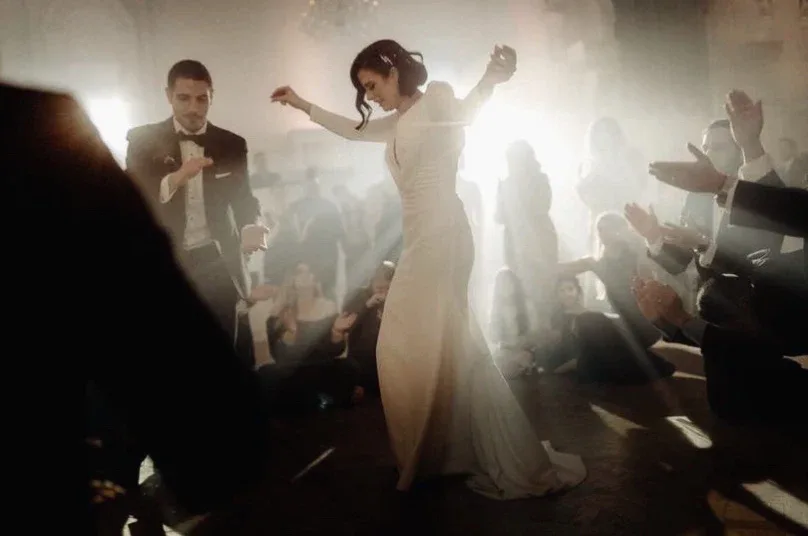
Pacing: how long a set runs, and how you leave it
A traditional block has a natural length. Run it too short and it feels like a token gesture, and the family it belongs to notices immediately. Run it too long and you will watch the floor thin out song by song, and now you have to rebuild the room from nothing.
Our rule is to end a set while it is still full. Not when it dies, not when the last four people are holding hands out of politeness. While it is still peaking. That leaves everyone wanting more, and it gives us somewhere to go later.
Which is the other half of the answer. We would rather run two shorter traditional sets, one early and one deep in the party, than one long one. The second one hits harder because the room is warmer, everyone has had a drink, and the people who were shy at eight o'clock are not shy at eleven.
Then there is the seam itself. Getting from a Greek set into a modern set is not a song problem, it is a tempo and key problem. The two tracks either side of that seam decide whether the floor holds or empties. Get it right and most guests never consciously notice a change happened, they just keep dancing. Get it wrong and you can lose a full room in thirty seconds and spend twenty minutes earning it back.
That is the actual craft in a mixed wedding, and it cannot be planned from a spreadsheet. It gets decided live, by someone watching the floor, who has done it enough times to feel it coming.
Read the room by family, and speak its languages
At a mixed wedding the dancefloor is not one crowd, it is four or five at once. One side's parents. The other side's parents. The cousins. The couple's friends from work who know nobody. The kids.
Those groups do not respond to the same music and they do not peak at the same time. A DJ watching "is the floor full" is missing most of the picture. A DJ watching which families are on the floor knows what to play next, and knows when one side has been sitting for too long.
This is also why we bring a lead DJ and a supporting DJ to every wedding. One of us is always looking at the room rather than at the equipment.
The same goes for the microphone. If half your guests are more comfortable in French, or in Arabic, or in Greek, hearing their language from the mic is the difference between being at the wedding and watching it. Our team MCs in English and French all night, and where a moment calls for a word in the family’s language, we make sure it is said properly rather than attempted badly.
Live musicians, and where they fit
Bouzouki, tabla, oud, duduk, saxophone, percussion. Live players raise a room like almost nothing else, and at a mixed wedding they are a clean way to honour one side without spending an hour of the timeline on it.
Two things matter. First, the handoff. A live set and a DJ set should never collide and the room should never go silent between them, which means the musicians and the DJ have to be planned together rather than booked separately and introduced on the night. Second, placement. A live set is a peak, and you cannot have three peaks in a row. We slot it where it lifts the night rather than competing with it.
Live saxophone and percussion are part of our own crew, and we work alongside musicians and bands that couples book directly. Either way, we coordinate it.

What we actually need from you
Less than you think, and different from what you expect.
We do not need you to send us a list of songs from your own culture. Building those sets is our job, and if you send us the list we will probably come back with the three you forgot.
What we need is you. Your taste, your must plays, the songs you never want to hear, and the moments that are non-negotiable for each family. We ask for two playlists, one for cocktail and dinner and one for the party, because that is how we learn who you are. Then we build everything else around it.
We meet with you two to four times before the wedding to go through the music and the schedule properly. By the time we get to the day, nobody is guessing.
The short version
- Do not split the night by culture. Build one line and put the cultures inside it.
- Tradition goes early, while the grandparents are still there.
- End every traditional set while it is still peaking.
- Watch which families are dancing, not how many people.
- Say it in their language.
Two families, one night.
If your wedding is bringing two cultures into one room, send us your date. We will tell you the same day whether it is open, and we would love to hear how you are thinking about the night.
